Here are some examples.
Happy Valentine's Day! It is Tunisia, early 1943. The British were attempting to ward off a German armoured counter-attack as they slowly push them out of North Africa. This is what some of them were using...


This is a Vickers Vildebeest. Top speed was 143 mph, with a defensive armament of two .303 caliber machine guns. It had no armour or self-sealing fuel tanks which had become standard at least a year earlier on all British combat aircraft.



Can Anyone In This Country Design A Tank?: The British didn't field a really competitive medium tank - the Comet - until 1945, in spite of having been in the war for six years! Tanks require a balance of armour protection, firepower and speed. They also need to be mechanically reliable. Every single British medium tank the British produced in WW2 failed to meet one or many of these requirements throughout almost the entire war!


Again, as with the A9 and A10, these tanks look very similar. The difference is in turret design to provide armour sloping in the Cruiser IV, and armour protection which was increased from 14 mm in the Cruiser III to 30 mm in the Cruiser IV.


The Comet was fast, it had a low profile, it was well protected and had an excellent gun. It also had a very reliable engine. It would remain in British service until 1958, and with some other countries into the 1980s.
The Valentine Mark III infantry tank.
British tank crews had to take on a few of these German tanks....
British tank crews had to take on a few of these German tanks....
The Tiger Mark I.
The Valentine weighed 16 tonnes, and had a maximum of 65 mm of frontal armour. It had a 2-pounder (40 mm) gun. It's maximum speed was 15 mph.
The Tiger weighed 54 tonnes, and had a maximum of 100 mm of frontal armour. It had an 88 mm gun. It's maximum speed was 23 mph.
The gun of the Valentine could not penetrate the armour of the Tiger at any range. The gun of the Tiger could penetrate the armour of the Valentine more than 2 km away.
The British had been at war for four and a half years by early 1943. How is it possible that they were sending tankers into combat in Valentines where they faced certain death not only against Tigers, but also against most German tanks of that era? They did have better tanks than the Valentine - the Churchill for example - but even as late as 1943 they continued to kill their own people by sending them into combat in these death traps.
Here is another example of British abject stupidity...
Low and Slow: This is what the British sent out to try to torpedo Japanese warships and transports during their invasion of Malaya in December, 1941.
Low and Slow: This is what the British sent out to try to torpedo Japanese warships and transports during their invasion of Malaya in December, 1941.
This is a Vickers Vildebeest. Top speed was 143 mph, with a defensive armament of two .303 caliber machine guns. It had no armour or self-sealing fuel tanks which had become standard at least a year earlier on all British combat aircraft.
This is what the men flying these planes faced...
This is a Nakajima Oscar. Maximum speed of the Mark 1 version was about 308 mph, with two .303 caliber machine guns.
Almost no Vildebeests survived their encounters with Japanese fighter aircraft. Pilots flying this aircraft did claim to have sunk eight Japanese ships while defending Malaya, which is close to a miracle, and which speaks to the high quality and bravery of the aircrew.
The British did have a much better torpedo aircraft - the Bristol Beaufort - a few of which were actually in Singapore in 1941. But they didn't get enough of these more useful aircraft to Singapore in time, so they had to use these these death traps instead. What were they thinking?
Let's go back to North Africa..
Cannon Fodder: Here are the two primary fighter aircraft that the British used through 1941 and 1942 to try to defeat the German Me-109, which was the primary German fighter aircraft in the theatre...
Cannon Fodder: Here are the two primary fighter aircraft that the British used through 1941 and 1942 to try to defeat the German Me-109, which was the primary German fighter aircraft in the theatre...
The Hawker Hurricane Mark II...
The Curtiss P-40E...
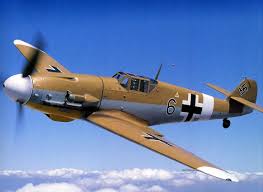
The Germans were using these...
The Me-109 F.
The German fighter was about 50 MPH faster that the Hurricane Mark II, and about 30 MPH faster that the P-40E. It could out climb both, and had a much higher service ceiling.
The Germans kept it simple. They flew higher than the Hurricanes and P-40s, swooped down from heights that the other two planes could not reach, gunned them down, and flew away. They shot down hundreds of Hurricanes and P-40's this way.
The British did have an aircraft that could compete with the ME-109 F; the Spitfire Mark V. They didn't send this plane to North Africa and Malta until March 1942. The Luftwaffe arrived in North Africa in April, 1941. This meant the Brits left their fighter pilots to take on Me-109's in their Hurricanes and P-40s for almost a year before a really competitive fighter plane was sent.
The Venerable .303!: In the 1930's the British had to decide what weapon they would use to arm their bombers and fighters for future wars. They looked at the .303 machine gun, .50 calibre machine gun, and 20 mm cannon. They decided that Browning machine guns using the .303 bullet would be used to arm their fighter aircraft and their bombers to defend against enemy fighter aircraft.
The British did have an aircraft that could compete with the ME-109 F; the Spitfire Mark V. They didn't send this plane to North Africa and Malta until March 1942. The Luftwaffe arrived in North Africa in April, 1941. This meant the Brits left their fighter pilots to take on Me-109's in their Hurricanes and P-40s for almost a year before a really competitive fighter plane was sent.
The Venerable .303!: In the 1930's the British had to decide what weapon they would use to arm their bombers and fighters for future wars. They looked at the .303 machine gun, .50 calibre machine gun, and 20 mm cannon. They decided that Browning machine guns using the .303 bullet would be used to arm their fighter aircraft and their bombers to defend against enemy fighter aircraft.
Choosing the .303 calibre round did make some sense when the decision was taken in the 1930's. At that time, virtually no military aircraft had armour or self-sealing fuel tanks. Other world powers were arming aircraft with equivalent weapons, with the Americans often using one .30 calibre and one .50 calibre machine gun; the Italians using .50 calibre machine guns; the Germans using 7.62 calibre machine guns; and the Japanese using 7.7 mm machine guns. The French and Soviets were experimenting with rifle calibre machine guns, like the British, but they also added single or double 20 mm cannons.
Unlike other nations, the British made up for lack of punch with numbers of guns deployed. The Hawker Hurricane and Supermarine Spitfire fighters that they fielded at the started the war had a whopping eight .303 machine guns, with four guns in each wing. These aircraft performed exceptionally well during the Battle of Britain, proving competitive with any aircraft fielded by the Germans or Italians.
After that battle, the British started to arm their fighters with a combination of .303 machine guns and 20 mm cannons, or with four 20 mm cannons. The cannon they used - the Hispano-Suiza - was excellent. By the end of the Second World War, other than some specialized German aircraft, the British probably had the most powerfully-armed fighter aircraft in the world, other than the ME 262.
The problem wasn't with their fighters. It was with how the British armed their bombers.
The .303 calibre machine gun was the primary defensive weapon arming British bombers throughout World War Two. All other nations started out defending their bombers almost entirely with rifle-calibre weapons; only the British persisted in doing so for the entire war. No other nation stayed only with these weapons, and instead they adopted a range of .50 calibre machine guns and 20 mm cannons to defend their bomber crews.
Long after it was obvious that German fighter aircraft had enough armour and self-sealing tanks to very often render these weapons ineffective, the British kept sending bomber crews into the air to try to fight their way through with .303's. The spectre of British gunners in their power-operated turrets armed with two or four .303 machine guns trying to hold off Messerschmitt 262 fighter jets armed with four 30 mm cannons is haunting. The Germans didn't have to get close. They could sit well outside of the effective range of the .303 machine guns, and just blow the bombers away.
There is an argument used by defenders of the decision to use the .303 that it was an effective weapon until the end of the war as the British bombed at night where air battles were at quite close range, where it could be effective. The response is to note that the British had to bomb at night as gunners using the .303 Browning proved almost totally incapable of defending their bombers in daylight, even as early as the first weeks of the war. The .303 was used at night because it was a total failure during daylight hours, not because the British were trying to fight battles at close range at night. Note that the Canadians, who built a version of the British Avro Lancaster bomber, started to install mid-upper gun turrets armed with the American .50 Browning machine gun toward the end of the war. The British themselves soon followed suit.
By the end of the war, it is fair to say that the .303 Browning had been effectively obsolete as a defensive weapon for bombers for at least two and maybe even three years. That the British continued to use this weapon to defend their bombers was a travesty. It is worth noting that the first British bomber produced right after the war - the Avro Lincoln - had a turret armed with two 20 mm cannons.
This shows you the difference in the size of the respective shells - see the top three shells. In the scenario where the ME262 took on the Lancaster, the Germans were armed with weapons that fired the round on the bottom of this display, while the British were armed by weapons that fired the round at the top.
Can Anyone In This Country Design A Tank?: The British didn't field a really competitive medium tank - the Comet - until 1945, in spite of having been in the war for six years! Tanks require a balance of armour protection, firepower and speed. They also need to be mechanically reliable. Every single British medium tank the British produced in WW2 failed to meet one or many of these requirements throughout almost the entire war!
The British started with the A9 and A10 medium tanks. They had very good 2 pounder (40 mm) guns that were probably the best anti-tank guns in the world in 1939. Here they are...
A9 Cruiser Mk 1
A10 Cruiser Mk II

They look very similar. The A9 had two machine gun turrets in the front that were virtually useless, so they were deleted in the A10.
These vehicles were very unreliable. Their treads tore off if they tried to turn too tightly. The board here at Mewetree.blogspot.com does recall reading an account of the British using some of these tanks in an attempt to defend Greece - about 50 tanks. The author claimed that all of them broke down before they could engage the enemy and had to be abandoned.
The A9 had very thin armour of only half an inch in thickness. That was not enough to stop rounds from 37 mm anti-tank guns which were standard with most armies in 1939-40. The British attempted to remedy this by putting 30 mm of armour on the A10. The result was that the speed dropped from 25 MPH in the A9 to a maximum of 16 MPH in the A10.
So the first cruiser tank that was produced was not well-enough protected and the second was too slow. They both lacked basic reliability. The British attempted to remedy the situation with the Cruiser III, and Cruiser IV. Here the are...
Cruiser III
Cruiser IV
Again, as with the A9 and A10, these tanks look very similar. The difference is in turret design to provide armour sloping in the Cruiser IV, and armour protection which was increased from 14 mm in the Cruiser III to 30 mm in the Cruiser IV.
These tanks were better than the first two cruiser tanks. The British had adopted the Christie suspension system, that enabled a high speed of 30 MPH. They retained the 2 pounder gun, which was still very competitive in 1940-41. However, both tanks were let down by a chronically unreliable engine, the Nuffield Liberty, which was a modified American WW1 aircraft engine. Here is an assessment of the reliability of this tank engine.
"The engine was notoriously unreliable in the North African campaign, largely due to specific tank installations (like the Crusader's poor air intake placement and chain-driven fans) that exacerbated its inherent design problems. Issues included overheating, water pump and ignition problems, and oil leaks from the individual, bolted-together cylinder assemblies, which were prone to separating under stress." (Wiki)
The armour protection of both tanks, and especially of the Cruiser III, was also too thin. It was easily penetrated by the 37 mm anti-tank guns used by the Germans, and the Cruiser IIIs sent by the British to France in 1940 were savaged by German tank and anti-tank gunners. The Cruisers III and IV were also sent by the British to fight in North Africa in 1940. There, it encountered Italian tanks, where they proved to be superior to what the Italians put into the field, although they were very vulnerable to Italy's 47 mm anti-tank gun which was used on their M13/40 tanks.
To summarize, the Cruisers III and IV were not well-enough protected and were let down by a chronically unreliable engine. Other than that, they were a significant upgrade on the Cruisers Mk I and II. They did well in North Africa against the Italians when their engines worked, then the Germans arrived and everything changed for the worse.
The next British medium was the Cruiser Mk VI "Crusader" which was the second most-produced British tank of WW2 (5.300 built), after the Valentine tank (about 8,300 built.) Here it is...
Cruiser VI "Crusader"
The Crusader had more armour than the Cruiser IV, with its maximum armour increased to 49 mm. The turret was also redesigned to slope the armour more so as to add more protection against anti-tank guns. The change to tank turret design and increased armour thickness was enough to render the German 37 mm gun largely useless. The Crusader was also quite quick, with a maximum speed of 26 MPH. So far, so good.
But the Germans mostly stopped using only the 37 mm anti-tank gun shortly after the Crusader was first introduced into service. In December, 1941, the Germans started using a new 50 mm Pak 38 anti-tank gun on their man battle tank at the time, the Panzer Mk III.
The 50 calibre version of this gun could penetrate 60 mm of armour at 1,000 meters. At this point in the war, the Panzer Mk III model H was also being introduced with a maximum of of 60 mm of armour protection. The venerable 2 pounder gun could only penetrate 40 mm of 30 degrees sloped armour at 1,000 meters.
The British in Crusaders were therefore both outgunned and outranged, as in, when the Crusader was introduced, its gun was already on the verge of obsolescence and increasingly outranged by the guns the Germans were using. Nonetheless, it was still useful, as there were still many Italian tanks around to shoot at.
The Crusader evolved from 1941 until production stopped in 1943. When introduced, it has a machine gun turret in front that was later deleted. The biggest change was the introduction of a very powerful 6 pounder (54 mm) gun staring in May, 1942. While this was a massive upgrade on the 2 pounder, and the new gun could effectively deal with any German tank, the gun was so large that the number of men in the turret had to be reduced from three to two. The commander became the gun loader as well as commander, which dramatically reduced his effectiveness in combat as it interfered with his ability to command the tank.
The need for a separate loader, gunner and commander in the turret had been recognized since at least the Battle of France, in 1940. Incredibly, the British did not design the Crusader's turret with a view to upgrading the gun, at least in such a way as to keep three men in the turret.
While crew crowding made this tank far less useful, the biggest problem with the Crusader was not the limitation to two crew in the turret. The biggest issue, by far, was the decision by the British to continue to use the same Nuffield Liberty engine in the Crusader that had proved so hopeless in the Cruisers Mks III and IV. While the Crusader was upgraded to be competitive with German tanks from 1941 to 1943 in terms of gun power, and even with slight improvements to the armour protection, crews were often beaten by their own engines which were well-known to be ineffective at the time the Crusader was introduced. There really was no excuse for this level of incompetence.
Consider that in 1942, while the British were fielding the Crusader III with mediocre armour, a very good gun and a good turn of speed, but a two man turret and a very defective engine; the Germans were using upgraded Panzer IVs and the first Tiger tanks, both of which had guns that could destroy a Crusader at over 1,500 meters; the Americans were using the mediocre General Lee and excellent Sherman tank; and the Soviets were using the T-34 which they put into service even before the Crusader. There is no question which of these tanks was inferior.
Again, they British built 5,300 of these tanks. They did not use it as a battle tank after the end of the North Africa campaign, switching as fast as they could to the Sherman.
Before looking at the next British medium tank that was actually used in combat, we need to mention the Covenanter. You may have noticed that we skipped one of the cruiser tanks, skipping over the Cruiser Mk V. Here it is...
Cruiser Mk V "Covenanter"
The British built 1,700 of these tanks. None was fit for combat as they used an innovative engine cooling system that put the radiators on the front of the hull to cool an engine which was designed to be kept as low in the vehicle as possible to reduce the profile of the tank. It didn't work. These tanks were all used for training. What a waste.
The increasing availability of American tanks in 1942-43 bought the British some time to design and thoroughly test a better tank, and to stop ordering tanks "off the drawing board" as they did for the first three years of the war. The result was the Cruiser VII Cavalier. Here is it...
Cruiser VII "Cavalier"
This tank was well-balanced, with very good speed, good armour and a very good 6 pounder gun. It had a gunner, loader and commander in the turret. The only obvious down side was the design of the front hull and turret which did not have sloped armour. Still, the armour was 76 mm thick, which was competitive, and the tank was only eight feet high, which allowed it to present a fairly low profile. By comparison, the General Grant tank that the British received from the Americans was ten and a half feet high, and even the Sherman was nine to nine and a half feet high.
So, all good, right!?
Well, no.
Are you ready for this?
The British used the Nuffield Liberty engine in this tank as well! This decision rendered the tank undeployable in combat, and the 500 examples built were mostly use for training. (If you are counting, that is 2,200 completely useless medium tanks produced by the British during the crucial middle years of the war!) It went into production in 1942, when, if it had a dependable engine, would have made it one of the best tanks on the planet, easily better than the Panzer III and first variants of the Sherman, and even competitive with the T-34-76.
It was not to be.
Before moving on to discuss the tank that came before the Comet, we need to chat about the British decision to not provide their tank crews with high explosive ammunition.
Most British tanks in North Africa were destroyed by German and Italian anti-tank guns. If you were in a tank, the best way to deal with an artillery piece was to blast it with high explosive shells from your own cannon. Until the next tank - the Cromwell - the British sent crews in British tanks into combat with machine guns and only armour-piercing ammunition for their anti-tank guns, until the start of the Tunisian campaign in late 1942
There were high explosive rounds developed for the 2 pounder and 6 pounder guns, but unbelievably, they were not provided to tank crews for the first two years of the war in North Africa. This situation changed when the British started to receive first Stuart Honey tanks, then General Grant and then Sherman tanks from the Americans that had 37 mm, then 75 mm guns respectively that could fire both high explosive and armour-piercing shells.
Here is what was quite often knocking out Crusaders in North Africa..
This 88 mm Flak 18/36/37/41 gun fired an 88 mm armour-piercing shell that could penetrate 88 mm of armour at 2 kms range. The Crusader had 49 mm of sloped armour. When fired upon, British tank crews were expected to use their machine guns or armoured rounds in response. The British tank machine gun was the Besa. It's effective range was no more than 1,000 meters. Unless British tank crews could call in artillery to deal with German anti-tank gun crews, they had no way to effectively respond prior to the introduction of American tanks with their high explosive rounds, and prior to the introduction of high explosive rounds for the 6 pounder rounds in late 1942.
Yup.
The next tank is the Cromwell. Here is it...
Cruiser VIII "Cromwell"
The Cromwell was basically the Cavalier with a different engine and a 6 pounder gun that had been modified to accept the 75 mm round used in the Sherman's gun.
This was a very good tank. It was quick, it had 76 mm of armour, and a 75 mm gun. The British finally scrapped the Nuffield Liberty engine and installed a version of the Rolls Royce Merlin called the Meteor engine, giving it a top speed of 40 MPH with 600 horsepower. This was an excellent and reliable engine. This tank was operated with the American Sherman by the British and Canadians in the Normandy Campaign where it performed well.
So why was this tank not the one that we can say the British finally got right and produced a war-winner? There were two problems with this vehicle.
The first was that the 76 mm of armour was still not sloped. That was probably acceptable on the Cavalier which was produced as early as 1942. By 1944, the battlefield had evolved so that flat armour was simply not competitive.
Let's chat about sloped armour.
The Sherman had receives a bad rap because it only had 2 inches or armour on its front hull. But that armour was heavily sloped, so that the effective armour protection wasn't 2 inches (50 mm), it was between 90 and 94 mm. By comparison, the Cromwell was protected by only 64 mm of flat armour on the hull and 76 mm of flat armour on the turret.
The second problem with the Cromwell was its gun. The move to a 75 mm gun was an advance on the 6 pounder, as it allowed British tank crews to fire a much more effective high explosive round. But the armour penetrating power of this gun was deeply deficient. The gun could only penetrate 68 mm of armour plating sloped at 30 degrees at 500 meters. By way of comparison, the 6 pounder gun that it replaced could fire an armour piercing round that could penetrate 112 mm at 500 meters!
By 1944, the Germans were using Panther tanks. They had 80 mm of heavily sloped frontal armour that gave them about 140 mm of effective armour protection on their front hull. The standard British 75 mm armour piecing shell could not penetrate this armour head on, forcing British tank crews to try to get side on shots at Panthers. The tanks' speed helped here, but Panthers could kill Cromwell tanks at any reasonable combat range, as the Panther had a long-barreled 75 mm gun that could fire a round that could penetrate 89 mm of 30 degree sloped armour out to 2 kilometers! The Cromwell was simply not competitive against these tanks, or even against the older Panzer IV tanks that the Germans used which used long-barreled 75 mm guns that could penetrate 82 to 97 mm of armour plating at 30 degree sloped angles out to 1,000 meters.
With the Cromwell, the British were almost there! The last medium tank they fielded in numbers was the Comet. Here is it,...
A34 Cruiser Mk I "Comet"
The Comet was one of the best medium tank produced during the Second World War. A total of 1,200 were produced and it entered combat in December, 1944. The Comet had a "77" mm gun, which was really a "detuned" 17-pounder, which was a 76.2 mm gun. The Comet's gun used a shortened version of the 17-pounder's round, and was excellent, able to put an armour-piercing round through 118 mm of armour at 1,000 yards. Using an APDS (Armour Piercing Discarding Sabot) round, it could penetrate 231 mm.
The Comet had more armour than the Cromwell, with 3.98 inches of sloped armour on the turret, and three inches on the hull, which was still flat! This armour could not stop an armour-piercing round from a Panther, but at least the Comet could kill the Panther in return.
The Comets set the pattern for what came after, which was the Centurion tank, which was arguable the first ever main battle tank..
Conclusion: Every major combatant fielded questionable equipment during the war, from the Elefant tanks of Germany, to the T-26's of the Soviet Union, to the abysmal tanks of the Italians and Japanese. The British weren't alone. The examples above do show a certain bloody-mindedness though.
.
.

No comments:
Post a Comment